

Summary
AI in CRM is no longer a future investment; it is an operational decision that is already separating high-performing sales and service teams from those falling behind. This blog breaks down what AI in CRM actually does, how it improves sales performance, service resolution, and customer retention, and what to look for when evaluating an intelligent CRM system for your business.
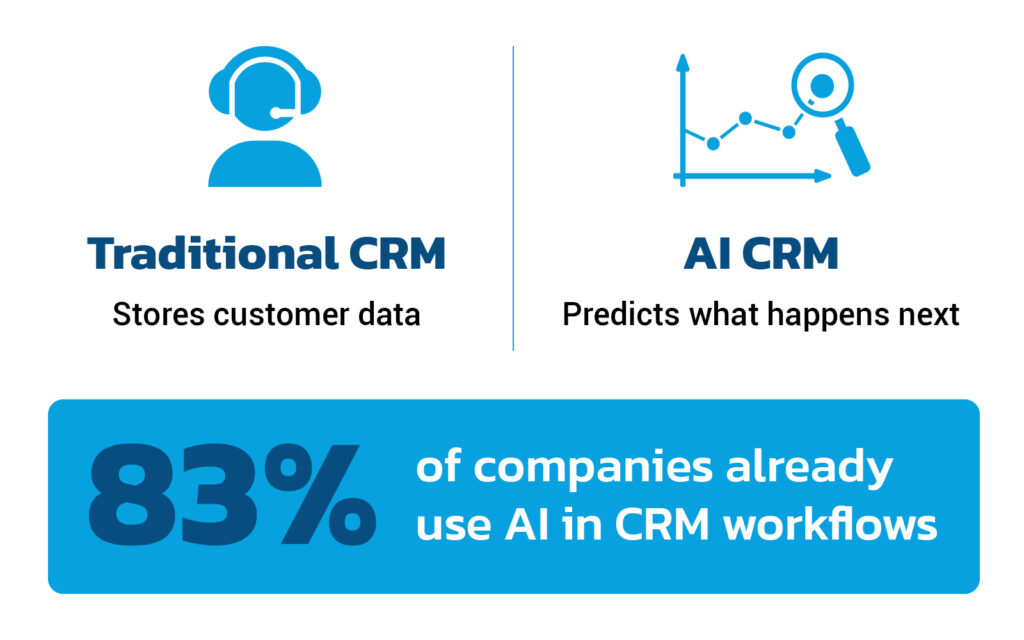
According to DemandSage’s 2026 CRM Statistics Report, about 83% of companies already use AI in their CRM workflows. AI helps businesses respond faster, with companies seeing a 30-50% improvement in response times.
It also enhances customer interactions, with 65% of businesses reporting better engagement thanks to AI-powered virtual sales assistants. By automating routine tasks and improving efficiency, 41% of companies have already cut costs with AI-driven CRM systems.
The gap between teams deploying artificial intelligence (AI) in CRM and those that are not is no longer marginal; it is structural, and it is showing up in operational efficiency and customer outcomes.
Behind those improvements are three persistent problems that most sales and service teams are still carrying: reps prioritizing the wrong accounts, service teams discovering issues too late, and customer churn that nobody saw coming.
This blog covers how AI in CRM addresses all three, what the technology actually does, how it changes what your teams can execute, and what separates an intelligent CRM system from one that just stores data.
What Is AI in CRM?
AI in CRM (Customer Relationship Management) transforms static databases into proactive systems of intelligence. By integrating artificial intelligence, businesses automate routine tasks, predict customer behavior, and deliver hyper-personalized experiences at scale, ultimately driving higher conversions and operational efficiency.
A basic CRM logs activity, but an intelligent CRM system interprets that activity, identifies patterns, predicts outcomes, and automatically triggers actions. One tells you what happened; the other tells your team what to do about it before the opportunity closes.
Difference Between Traditional CRM vs AI CRM
| Capability | Traditional CRM | AI-Powered CRM |
|---|---|---|
| Data Storage | Organizes contact and deal information | Aggregates sales, service, order, and fulfillment data |
| Decision Support | Reports what happened historically | Predicts what happens next with precision |
| Lead Management | Manual review of all prospects | Automated scoring and ranking of high-value opportunities |
| Case Handling | Routed manually by assignment rules | Intelligently routed with full account context pre-loaded |
| Workflow Execution | Rule-based automation triggered by manual actions | Agentic automation that detects patterns and acts independently |
| Customer Risk | Discovered after churn occurs | Flagged in advance with recommended actions |
| Personalization | Segment-based messaging | Account-specific recommendations from actual history |
How AI in CRM Actually Works: The Tech Layer in Plain Language
AI in CRM platforms operates on four core technologies:
Machine Learning reads historical data (closed deals, lost deals, churned customers) and learns what patterns lead to each outcome. As data accumulates, predictions sharpen.
Predictive analytics scores current leads, flags accounts that show risk signals, and forecasts pipeline closure with accuracy beyond that of stage-based probability models.
Natural language processing (NLP) reads emails, support tickets, and call transcripts, performing sentiment analysis to identify frustrated customers, urgent service issues, and strong buying signals without manual review.
Agentic workflow automation crosses from insight into action. AI agents escalate cases when sentiment deteriorates, route high-value opportunities when signals shift, and trigger retention outreach the moment an account starts to behave as if it's about to leave. Unlike rule-based automation, agentic systems detect patterns and act before a human identifies the problem.
How AI Improves Sales Performance
Businesses using AI in CRM are 83% more likely to exceed sales goals. AI enhances sales forecast accuracy by over 40%, eliminating the gap between stage-based assumptions and what is actually closing.
Lead Scoring and Pipeline Prioritization
AI-powered automated workflows can instantly assign high-priority leads to the appropriate sales representative, ensuring valuable opportunities receive immediate attention.
For manufacturers and distributors managing large portfolios across multiple sites, this is the difference between high-value deals advancing and sitting idle.
Faster Quote-to-Order Workflows
AI checks live inventory, confirms delivery dates, and handles product configuration inside the CRM, removing delays between quote and order confirmation.
That gap is where deals stall, and competitive deals are lost.
Cross-Sell and Upsell Recommendations
AI surfaces specific opportunities based on account order history; for example, a customer who regularly orders one product but has never ordered a complementary one that similar accounts buy together.
Recommendations are account-specific, not generic.
Business Outcome Forecasting
AI analyses historical sales performance, deal velocity, win rates, and seasonality to forecast what will actually close, delivering precision beyond stage-based models.
How AI Improves Customer Service
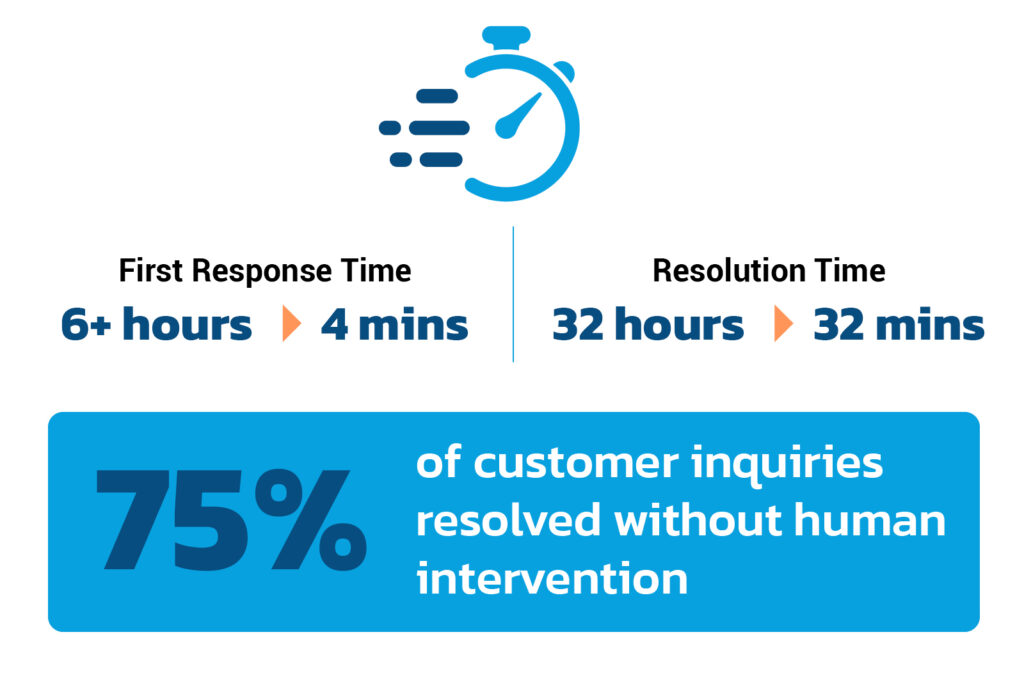
AI has reduced first response times from over 6 hours to less than 4 minutes and resolution times from 32 hours to 32 minutes, an 87% improvement. 75% of customer inquiries can now be resolved by AI tools without human intervention.
Smarter Case Routing and Faster Resolution
AI combines sentiment analysis with case classification to identify customers who may require urgent attention, helping service teams prioritize issues before they escalate.
This removes manual assignment delays and back-and-forth that slow resolution.
Warranty and Returns Visibility
AI aggregates warranty and returns data, surfacing which products generate the most returns, which accounts carry open warranty exposure, and where repeat issues appear across the installed base.
For manufacturers, this visibility prevents service blind spots created when service data lives separately from sales and order data.
Connected Order, Fulfillment, and Service Data
Intelligent CRM systems bring order status, fulfillment data, and service history into one view. Service reps can answer questions about delivery, outstanding orders, and open issues without switching tools.
A customer’s service question is almost always connected to an open order or delivery timeline; without that context visible, the conversation starts on the back foot.
Data Management Automation
AI automatically captures, updates, cleanses, and enriches customer records without manual intervention.
Data entry errors that create service blind spots (missing contact details, outdated order information, and incomplete histories) are eliminated through continuous background validation.
How AI Strengthens Customer Retention
CRM use boosts customer retention by 27%. Sub-one-hour email responses achieve 71% retention compared to 48% for 24-hour responses.
Early Warning Signals Before a Customer Leaves
AI monitors account behavior, flagging patterns of declining order frequency, rising service complaints, and slower outreach response.
Account managers receive a specific list of at-risk accounts with reasons attached before anything is canceled. This is meaningfully different from discovering a customer has left and then reconstructing what went wrong.
Prioritizing High-Value Accounts
AI surfaces which accounts need attention right now, based on combined revenue size, renewal timing, recent activity, and risk signals.
For distributed operations managing hundreds of accounts, this is the difference between proactive relationship management and hoping nothing slips through.
Personalized Outreach Based on Account History
AI recommends what to say and when to say it, based on each account’s purchase history, service record, and engagement data.
The outreach is specific to that account, not a segment message sent to everyone. Response rates reflect this distinction.
Proactive Customer Engagement
AI automatically triggers renewal reminders, follow-up communications, service check-ins, reorder prompts, and account reviews based on customer lifecycle stage and buying patterns.
A customer approaching annual contract renewal receives a check-in before the renewal notice is due.
What to Look for in an Intelligent CRM System
When evaluating CRM solutions, prioritize these capabilities:
Connected data across your entire operation
The CRM must pull in order data, fulfillment data, service records, and sales activity because AI agents are only as useful as the data they can act on. A system that cannot see fulfillment cannot explain service issues or identify exposed accounts.
Actionable outputs, not just scores
Lead scores without context and churn flags without recommended actions do not change what reps do on Monday morning. Outputs must be specific, usable, and tied to a next step.
Customizable dashboards for your industry
Sales teams, service managers, and account leaders each need different visibility. The platform must support this without creating IT backlogs every time reporting requirements shift.
Agentic automation built in
AI agents act when the system detects a pattern, not only when someone manually triggers a rule. This timing difference, especially in retention and service contexts, often separates a resolved situation from a lost account.
Deal risk alerts with context and action
Risk flags should come with the signal that triggered the alert and a recommended next step. A score sitting on a dashboard does not change behavior.
How Bits In Glass Helps You Get AI in CRM Right
Bits In Glass works with mid-market and enterprise organizations to assess where their current CRM and data setup stands, identify the specific gaps in sales, service, and retention workflows, and implement intelligent CRM systems built around how their business actually runs.
Bits In Glass holds Creatio Premier Partner status, one of only five companies globally with that designation. That position reflects the depth of certified expertise we bring to every implementation, and it translates directly into faster delivery, lower risk, and systems that are built correctly from the start rather than corrected after go-live.
Our Manufacturing Customer360 accelerator is a concrete example of what that looks like in practice: a pre-built solution that connects quote, order, fulfillment, and service data into a single view, designed specifically for manufacturers and distributors who need more than a generic CRM can provide.
To explore what AI in CRM could look like for your operation, speak with Bits In Glass’s CRM team.
Frequently Asked Questions
A standard CRM organizes customer data; an AI-powered CRM analyzes that data to score leads, flag risks, recommend actions, and trigger automated workflows. A standard CRM records what happened; an intelligent CRM tells your team what to do about the situation happening now.
No. AI handles analytical and administrative work, freeing teams to focus on conversations, relationships, and decisions that require judgment. The people stay; they stop doing work a machine can do more accurately and faster.
Implementation scope, existing systems, and workflow configuration determine the timeline. With a no-code platform like Creatio and an experienced partner, many businesses can go live in months rather than years. Pre-built, industry-specific accelerators further compress that timeline.
Most modern CRM platforms, including Creatio, allow you to add AI capabilities to your existing system without replacing it entirely. Older platforms may have limitations. An assessment of your current setup will determine whether you can extend what you have or transition to a more AI-ready platform.